Fear, envy, anger, and hatred as refusals: a reading inspired by Rumi and Sufism
A text by Vozes do Silêncio, inspired by Rumi, Mira Bai, and Sufism, defines poison as a lack of measure and sees in love the answer to fear, envy, and hatred.
· 3 min read · Sources

In 1 minute
- The text, adapted from Rumi, Mira Bai, and Sufism, defines poison as a lack of measure, and fear, envy, anger, and hatred as forms of non-acceptance.
- The answer to all of them is love, presented as the reason for the world's creation and as what gives meaning to dance, prayer, and music.
- It ends by recalling that the soul already knows what it seeks, that time is short, and that the path of love requires daring to fall.
Full article
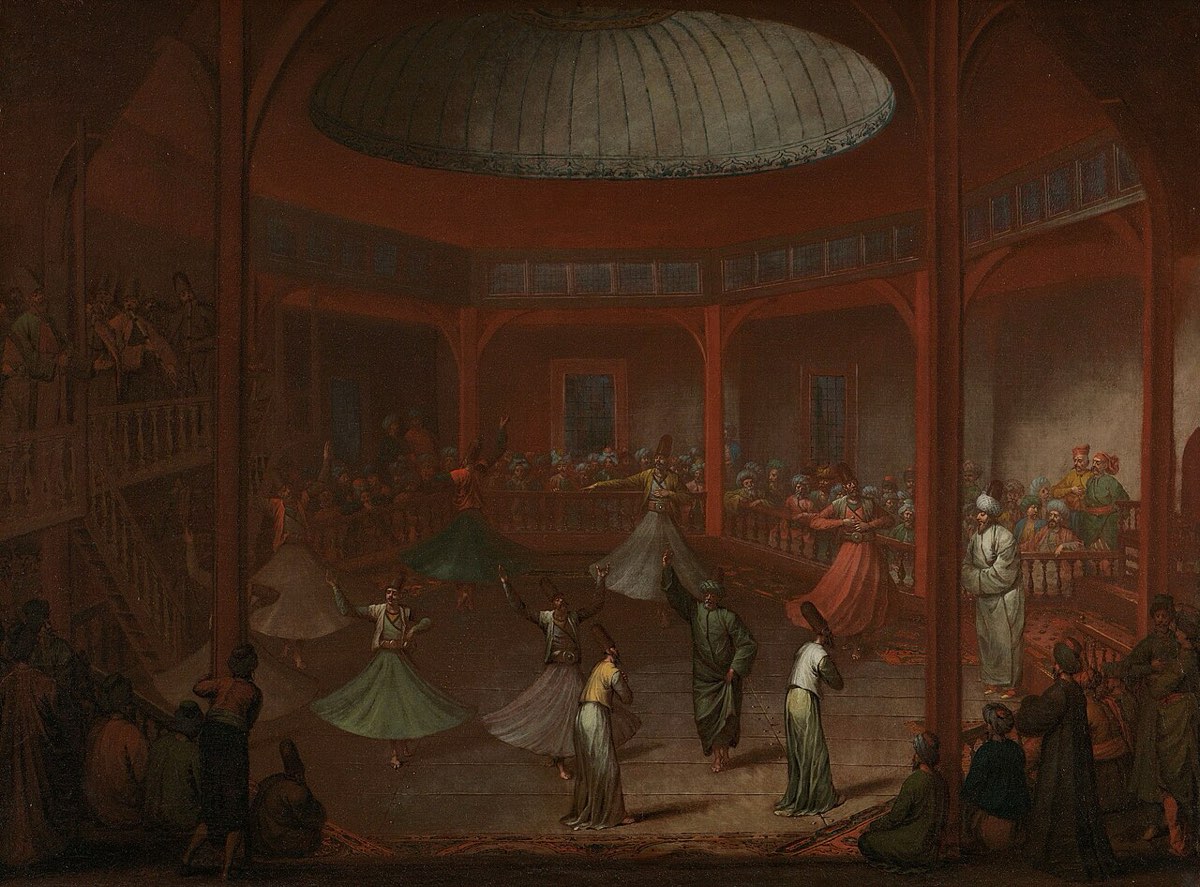
“What is poison?” The question opens a text signed by Vozes do Silêncio and inspired by two voices from distinct centuries and places. Rumi (1207 to 1273) was a thirteenth-century Persian Sufi poet and theologian, and Sufism is the mystical, contemplative current of Islam, which seeks an intimate, direct relationship with God. Mirabai (1498 to 1547), or Mira Bai, is considered the most important Hindu poet of medieval India, author of devotional poems and songs.
The author doesn't say which poems or works the lines were drawn from, which makes the text a free reading of these traditions rather than a translation. The thesis fits in a few lines: fear, envy, anger, and hatred would be variations on the same refusal, and love is what dissolves them.
Poison is the lack of measure
For the text, poison is anything that exceeds what is needed. It can be power, ego, or even love, when it turns into attachment. Eating, waiting, controlling, accumulating, and desiring in excess poison in the same way. Abundance loses its soul and desire becomes sick.
In this key, the problem rarely lies in what is desired, but in how much.
Four forms of non-acceptance
The author defines each difficult emotion by what it refuses. Fear would be the non-acceptance of uncertainty: if someone accepted that nothing is under control, fear would become adventure. Envy would be the non-acceptance of goodness in another, and someone else's shine only bothers us when we fail to recognize our own.
Anger would come from not accepting what escapes our control, and hatred, from not accepting people as they are. In each case, the proposed way out is acceptance: anger turns into tolerance, another's success turns into inspiration, and in the place of hatred, love blossoms.
Love as center
The line from Rumi the text quotes sums up its thesis: “Love is the bridge between you and everything.” Without love, the author states, dance is mechanical, prayer is duty, music is noise, and life is a repeated cycle. With it, even rain turns to pearl.
Hence the idea that love moves the world. The text recalls verses attributed to the Sufi tradition in which God created the universe out of pure love, so that the glory of love would be known. In light of this, life, challenges, time, and emptiness would be merely a stage for it to reveal itself.
What the soul already knows
Other adapted verses speak of a love that arises as a flame in the chest, of poetry learned in the beauty of the beloved, and of a God who dances within the heart, where no one sees. The author calls this the secret dance every human being carries.
Truth, according to him, is not found in books, screens, or speeches. It would be found in the pause between one breath and the next, at the center of the chest. In silence, a person would recall what the soul already knows.
Falling to gain wings
The text recalls that the sun of life will set and asks that no effort be spared during the days that remain. The final image is of one who has escaped the cage and stands with wings spread open.
The path of love, the author admits, is not easy. He quotes Rumi to call it a doorway of devastation, and concludes that only those who dare to fall learn to fly.
Sources and references for this article
Vozes do Silêncio, text adapted from Rumi, Mira Bai, and Sufi wisdom
Rumi (Jalal ad-Din Muhammad Rumi), Wikipedia (in Portuguese)Mirabai, Wikipedia (in Portuguese)Sufism, Wikipedia (in Portuguese)Translated from Portuguese. This article was rewritten from a post on the original blog, in Portuguese. Read the original
Get the best articles of the week
One email a week, no spam. Unsubscribe anytime.
Read next
 The EastWhy we suffer: Buddhism, Taoism, and karma in Laércio Fonseca's reading
 The EastSexual transmutation: what Taoism, Tantra, and Alchemy propose about conserving energy
 Western esotericism · VideoKabbalah and the Tree of Life: a mystical map of creation, the soul, and the way back
 Western esotericism · VideoThe Kybalion, chapter 10: the Principle of Polarity and choosing your degree
 Indigenous peoples · VideoWorld Tribal Alliance founder makes the case for unlearning the human-nature split