Matías De Stefano argues humanity has lost sync with Earth's time
In Cusco, Argentine educator Matías De Stefano says the modern calendar broke away from Earth's cycles, and details a three-year plan tied to solar eclipses.
· 3 min read · Sources
Source video
World Tribal Alliance · “On Site in Cusco, Peru — a Conversation with Matías De Stefano”
More videos and documentaries in the Videos tabIn 1 minute
- In an interview recorded in Cusco, Peru, Argentine educator Matías De Stefano, a World Tribal Alliance ambassador, argues that the modern calendar broke the sync between the human body and Earth's cycles.
- He details a three-year project, which he calls Holy Nada, linking solstices, equinoxes and solar eclipses to an eclipse over Luxor, Egypt, expected in August 2027.
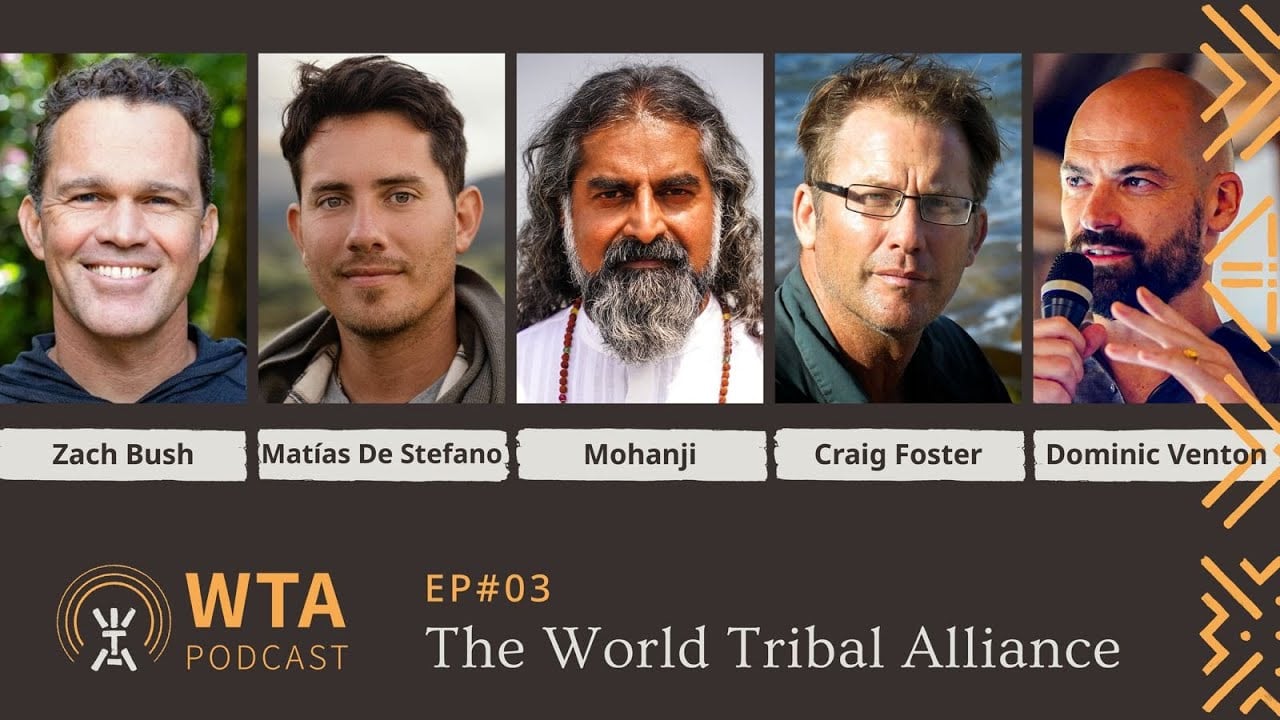
- De Stefano also talks about handing control of ceremonies to something larger, an idea he illustrates with an episode in which spiritual teacher Mohanji told him not to worry about an approaching storm.
Full article
At nearly 3,800 meters of altitude, fresh off a ten-hour drive from Lake Titicaca, Argentine educator Matías De Stefano recorded an episode of the World Tribal Alliance (WTA) podcast in Cusco, Peru, still short of breath from the trip. It took one question for him to reach the center of the conversation: for De Stefano, time as modern civilization measures it is, in his words, broken.
De Stefano, an Argentine born in 1987, became known at home as the "indigo child" who says he remembers past lives, the subject of the documentary "El Recordador" (2019). He later built a career of talks, series and journeys he calls education of consciousness, and now adds to that the role of WTA ambassador, an organization that brings together indigenous elders from different continents. The Cusco interview lays out the theory that, he says, underpins that whole body of work: the hypothesis that humanity has fallen out of sync with Earth's time.
A calendar out of step
De Stefano argues that today's calendar — seven-day weeks, twelve months of uneven length, dates that don't line up with solstices and equinoxes — fails to reflect the celestial rhythms that he says shaped human biology over millennia. He notes that human blood contains iron, like Earth's core, and argues that this inner magnetic field should follow the planet's cycles around the sun. That mismatch, he says, is why so many people report chronic anxiety: they would be living out of their own rhythm.
From that reading, De Stefano describes a three-year project he calls Holy Nada, an expression that blends the Sanskrit term for the transmutation of sound with the words "sacred" and "nothing," in English and Spanish. The plan divides the period into thirteen-day weeks, each tied to a chemical element of the periodic table, and uses twelve solstices and equinoxes plus seven eclipses as markers for ceremonies with elders from different regions. He places the peak of the cycle at a total solar eclipse expected on August 2, 2027, over Luxor, Egypt, lasting around six and a half minutes — a symbolic point, in his view, for falling over a region associated with the birth of alchemy.
Elders as sensors of the land
Before each solstice or equinox gathering, De Stefano says, his team travels through the region to do what he calls "asking permission" of the land. In his account of the most recent trip, to Lake Titicaca, a group of 32 people reportedly found a small broken stone labyrinth near a temple and read the scene as a metaphor for energy nodes of the planet that needed realigning. It is an admittedly intuitive method, with no verification possible beyond participants' own experience: De Stefano himself describes these findings as a game of clues, not research.
In this worldview, indigenous elders would hold knowledge passed down through generations as stories — why, for instance, a given season was linked to a zodiac animal. For De Stefano, that oral knowledge preserves practical information lost to urban culture, and WTA's role would be to amplify that voice, not replace it.
What surrender means here
Much of the conversation turns to a simpler theme: learning not to control what happens during a ceremony. The podcast host recalls an episode from an earlier WTA gathering in South Africa, when a ceremony tent stood on a beach hours ahead of a forecast for strong winds. He wanted to take it down; spiritual teacher Mohanji, WTA's founder, asked him to leave it as it was. The storm did not arrive in time to cause trouble, and the episode became, for both of them, a lesson in trusting how things unfold instead of trying to control them.
De Stefano generalizes the idea with a physics metaphor: he says each person behaves like a particle only because it is being observed, but that, underneath, everyone is a wave — part of the same ocean of consciousness. "I am just a point of gravity of something bigger," he sums up, explaining why, in certain places, he says he stops acting as himself and starts tuning in to what he calls the spirit of the place, as he says happened on a visit to Table Mountain, in South Africa, in 2012.
Nothing in the conversation is verifiable beyond what the participants themselves describe, whether the Titicaca gathering, the origins of the calendar De Stefano proposes, or the storm episode. What remains, in the end, is the bet that rehearsing this kind of collective trust, solstice after solstice, might produce something that calculation and planning alone could not.
Sources and references for this article
On Site in Cusco, Peru — a Conversation with Matías De Stefano. World Tribal Alliance, YouTube, 08 May 2026World Tribal Alliance, official siteMatías De Stefano, official siteEl Recordador (2019), entry on the documentary about Matías De Stefano, Wikipedia (Spanish)Get the best articles of the week
One email a week, no spam. Unsubscribe anytime.
Read next
 Indigenous peoples · VideoSpirit of the Andes: the documentary that takes Andean elders from Machu Picchu to Ausangate
 Indigenous peoples · VideoA Quechua guardian from Cusco argues rivers and rocks should be treated as rights-holders
 Western esotericism · VideoThe Kybalion, chapter 1: a tradition from teacher to student, and what history says
 Western esotericismThe Eye of Horus: the documentary linking Egypt to Atlantis, and what Egyptology says
 Indigenous peoples · VideoThe origin myth a Huni Kuin elder carried from Acre to South Africa