The Kybalion, chapter 1: a tradition from teacher to student, and what history says
The Kybalion, from 1908, presents the hermetic philosophy of Hermes Trismegistus as formation, not information; scholars date the hermetic texts to the 1st-3rd centuries.
· 3 min read · Sources
Source video
NEW ACROPOLIS · “Caibalion - Ep. 1 | O TODO está em tudo (Filosofia Hermética) • Lúcia Helena Galvão”
In 1 minute
- The Kybalion was published in 1908 under the pseudonym Three Initiates, and claims to contain the essence of Hermes Trismegistus's teaching in seven principles.
- The cycle's opening lesson distinguishes information, which piles up quickly, from formation, which demands time, ethics, and self-mastery, and reads hermetic knowledge as a call to the common good.
- For the tradition, the caduceus symbolizes harmony among body, psyche, and spirit, and alchemy is the work of transforming the ego; historians date the hermetic texts to the 1st through 3rd centuries.
Full article
Picture a dark temple with a single flame burning, kept alive across generations by guardians no one knows. That image opens the first lesson of a 15-session cycle devoted to The Kybalion, a book of hermetic philosophy, and it sets up what the teacher says next: knowledge is something handed down, and what is handed down can go out.
The Kybalion is one of the most cited books in Western esotericism, and also one of the most disputed when it comes to its origin. This piece presents the work, the figure of Hermes Trismegistus it draws on, the idea of formation the lesson defends, and what scholars say about its chronology. The claims about Hermes, initiations, and planes of being belong to the hermetic tradition and to the teacher's own presentation.
The book and its authors
The Kybalion was published in 1908 by the Yogi Publication Society, under the pseudonym “Three Initiates.” It claims to contain the essence of the teachings of Hermes Trismegistus as they were supposedly taught in the hermetic schools of Egypt and Greece, and it organizes them into seven principles, which the tradition says govern every plane of existence, from the subtlest to the densest.
Authorship was never officially acknowledged. The most common theory attributes the book to William Walker Atkinson, who owned the publishing house and wrote several books under pseudonyms, though other hypotheses circulate. The teacher, in the lesson, treats the work as heir to an ancient tradition, not as a twentieth-century invention.
Myth or master?
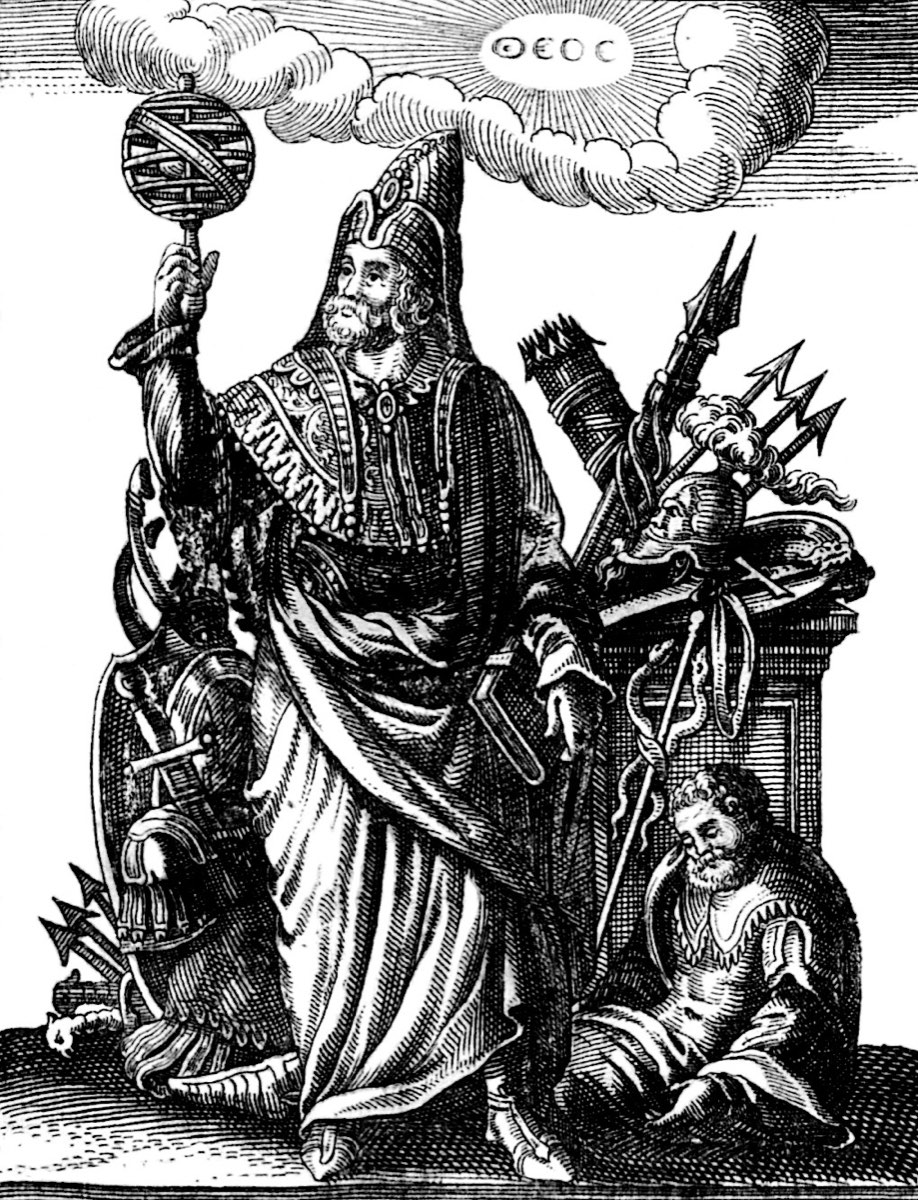
Hermes Trismegistus, “the thrice-great,” is, according to Wikipedia, a syncretic mythical figure drawing on the Egyptian god Thoth and the Greek Hermes. The tradition describes him as an Egyptian sage initiated three times, in body, soul, and spirit, and places him somewhere between 3000 BCE and 1500 BCE; the teacher himself acknowledges those dates are disputed. He is said to have been the master of figures such as Moses and Pythagoras, and the author of the Emerald Tablet.
Modern scholarship tells a different story. The hermetic writings, gathered in the Corpus Hermeticum, likely date from the first to third centuries CE, produced by various authors, with few properly Egyptian elements and a strong presence of the Platonism of their time. For the teacher, what matters is the legacy, not the chronology.
A flame passed mouth to ear
The teacher treats the tradition as a chain of transmission. Plato and Aristotle, he recalls, reached us because a handful of people protected their books from destruction. Hermetic knowledge, in turn, is said to have crossed millennia orally, from teacher to student. Hence the appeal he repeats: “Don't let this divine flame go out.”
From that chain comes a distinction the lesson underscores. Information is technical, accumulable, and fast. Formation is slow and demands ethics and self-mastery. That is why, the teacher argues, hermetic philosophy was never meant for the masses, but for those willing to grow inwardly and serve the collective good. He invokes a maxim attributed to Plato: powerful knowledge in unprepared hands is worse than ignorance.
The caduceus and the three bodies
The caduceus, a winged staff around which two serpents intertwine, is the emblem of Hermes and an ancient symbol found in images thousands of years old. In the esoteric reading, it represents the union of three spheres: the physical body, with instincts and matter; the psychic, with emotions and mind; and the spiritual, with wisdom and values. It falls to human beings, the lesson says, to harmonize the three so that the divinity within can manifest.
The same logic shapes the teacher's reading of alchemy. Medieval alchemists, in this view, were not chasing literal gold but the transformation of the ego's “lead” into the spirit's “gold.” For him, true alchemy is inward, and The Kybalion is above all a book of ethical and spiritual formation, to be studied patiently and applied in practice.
The forgetting of symbols
The lesson also turns critical of the present age. Even with all its technology, the teacher observes, modern civilization never created a symbol of its own for wisdom. It still uses Venus for love, Themis for justice, and Hermes for communication, a sign that it has drifted away from the symbolic dimension of existence.
He describes the present as a new obscurantism, no longer theological but materialistic and superficial. It is against that backdrop that The Kybalion is said to be circulating again, like a lit torch for whoever is willing to carry it forward. The cycle continues, in the next lesson, with an overview of the seven hermetic laws.
Sources and references for this article
Opening lesson of the 15-session cycle on The Kybalion_The Kybalion_, by Three Initiates (1908)Kybalion, Wikipedia (1908 publication, Yogi Publication Society, and authorship hypotheses)Hermes Trismegistus, Wikipedia (syncretic figure, Thoth, and dating of the hermetic writings)Caduceus, WikipediaTranslated from Portuguese. This article was rewritten from a post on the original blog, in Portuguese. Read the original
Get the best articles of the week
One email a week, no spam. Unsubscribe anytime.
Read next
 Western esotericism · VideoThe Kybalion and its seven principles: a 1908 book that speaks in Egypt's name
 Western esotericismA Hermetic manifesto against "selective blindness": mind, ether, and archons
 Vedanta and YogaVedānta: texts, schools, and the study method of one of India's six philosophies
 Vedanta and YogaGita, lesson 16: belief isn't knowledge, and the Veda as a mirror of the Self
 Western esotericism · VideoThe world as mistake and gnosis as the way out: the Gnostic cosmology of the archons