Atlantis, seven races, and ancient gods: an esoteric history of humanity
Daniel Cautembá proposes a history in seven spiritual races, with Atlantis and beings who allegedly taught humans; archaeology reads the same sites differently.
· 4 min read · Sources

In 1 minute
- Cautembá claims official history is only a fragment, citing Yonaguni, Göbekli Tepe, and the Sphinx as evidence of advanced ancient civilizations.
- In his narrative, today's humanity is the fifth of seven spiritual races, descended from survivors of Atlantis, and bodies of knowledge like the Vedas supposedly came from beings called gods.
- It's an esoteric vision with no supporting evidence: archaeology explains Göbekli Tepe, Yonaguni, and the Sphinx in a different way.
Full article
Göbekli Tepe, in southeastern Turkey, is a complex of stone pillar circles, many decorated with animal reliefs, raised around 9500 BCE. No one had agriculture at that time, and the site challenges the image of hunter-gatherers incapable of monumental construction. For archaeologists, it's a revision of what was known about the Neolithic. For Daniel Cautembá, who presents the channel Despertando Pessoas, it's evidence of something bigger: a human history far longer and more sophisticated than the one taught in schools.
What he proposes is an esoteric narrative that mixes real archaeological finds with beliefs from spiritual traditions. It's worth reading it for what it is, a worldview, and checking it against what academic research says on each point.
The evidence, and what archaeology says
Cautembá cites three sites: the submerged monument at Yonaguni, Japan; Göbekli Tepe; and water erosion on the Sphinx, in Egypt. Together, he argues, they suggest developed civilizations existed more than 10,000 years ago.
All three have well-established academic readings. Göbekli Tepe was occupied from roughly 9500 to 8000 BCE, in the Pre-Pottery Neolithic, and is considered one of the oldest known megalithic complexes — but the work of communities from that period, not of a lost civilization. Yonaguni, a submerged rock formation south of the island of the same name, is considered by most scholars a natural formation, though seismologist Masaaki Kimura argues it is roughly 2,000-year-old ruins. And on the Sphinx, the apparent erosion in the limestone comes mainly from wind and sand, with layers of differing hardness, according to Wikipedia's summary.
Seven races, one spiritual line
The core of the proposal is an evolution across seven great spiritual races, each with seven sub-races, within a cycle of Earth, which he calls Gaia. Today's humanity would be the fifth, the Aryan. Before it would come the protoplasmic, made of non-physical beings in subtle dimensions; the hyperborean, which develops the emotional body still within etheric planes; the Lemurian, the first in the physical dimension; and the Atlantean, a hugely advanced civilization that would have ended in a cataclysm, the "Universal Flood." The Aryan race would have arisen from a mix with survivors of Atlantis.
The scheme recalls Theosophical tradition, but the video presents it as the planet's spiritual history, not as a biological classification. There is no scientific basis for dividing humanity into races in this way.
The origin of ancient knowledge
Another theme is the source of complex bodies of knowledge. Cautembá cites the Vedas, which he considers humanity's oldest books, and says they deal with universal laws, subtle energies, chakras, astrology, alchemy, reincarnation, sacred geometry, and even principles of quantum physics. How would this be possible, he asks, if, according to official history, people didn't even know how to farm?
His answer is that ancient "gods," such as the Anunnaki, Brahma, and Thoth, transmitted this knowledge to primitive humans. They wouldn't necessarily be mystical deities, but highly evolved beings, perhaps from other cosmic civilizations.
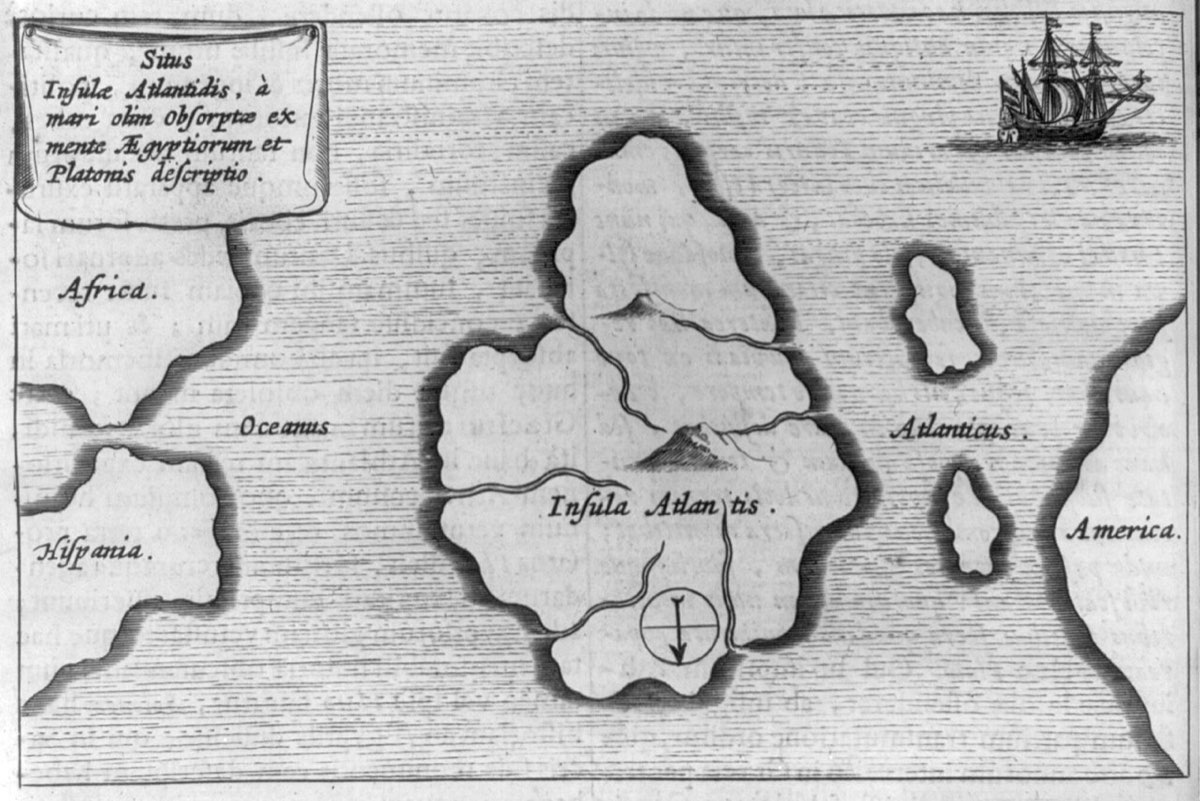
Atlantis
In the narrative, the Atlanteans grew corrupt through pride and spiritual imbalance, and a flood destroyed them. Survivors would have carried their knowledge to emerging peoples, such as the Sumerians, Egyptians, and Vedic cultures. The fifth race would have the task of awakening consciousness, understanding universal laws, and leaving the planet ready for a sixth.
The textual origin of Atlantis is well known: it appears in Plato's dialogues Timaeus and Critias, as part of an allegory about the arrogance of nations, and Wikipedia classifies it as a fictional island. The video takes the account as the memory of a real civilization, which is an esoteric reading, not that of philology.
A transition underway
Cautembá claims the planet is at the end of one cycle and the start of a transition: from the third dimension, material and dense, to the fifth, subtle and spiritual, and from the fifth race to the sixth. A divided humanity, disconnected from itself, would give way to a civilization united by awakening.
The temples and initiation schools of Egypt, he says, kept this knowledge orally. Today it would be reopening to the "prepared," through courses and practices that develop the self on three levels: material, emotional, and spiritual. The video comes from a channel devoted to this kind of training, which is worth keeping in mind when assessing it.
What remains
The proposal has the force of the great origin narratives: it gives meaning to the past and a task to the present. What it lacks is what sets it apart from academic history, verifiable evidence. What's left, concretely, is one real and uncomfortable fact: sites like Göbekli Tepe show that pre-agricultural humanity did more than previously assumed, without requiring a lost civilization to explain it.
Sources and references for this article
Video by Daniel Cautembá, channel Despertando Pessoas
Göbekli Tepe, WikipediaYonaguni, WikipediaGreat Sphinx of Giza, WikipediaAtlantis, WikipediaTranslated from Portuguese. This article was rewritten from a post on the original blog, in Portuguese. Read the original
Get the best articles of the week
One email a week, no spam. Unsubscribe anytime.
Read next
 Western esotericism · VideoYeshua and Sophia: a cosmic reading of Jesus and Mary Magdalene
 Western esotericismGnosticism: origins, schools, texts, and what survived the repression
 Death and beyond · VideoWhat souls do after death, in a Spiritist view: work, study, and service
 Accounts and channelings · VideoAshtar, "dormant" DNA, and the New Earth: why a channeled message resonates
 Western esotericism · VideoThe “1775 Bible” and the passages the Church allegedly suppressed: what is claimed