Was the Bible tampered with? What textual criticism and canon history show
No original of the Bible survived, and the copies carry variants; historical research documents them openly and finds no central plan of concealment.
· 5 min read · Sources

In 1 minute
- No original manuscript of the Bible survives today: every edition descends from copies of copies, made by hand over centuries, which explains the variants.
- Textual criticism compares thousands of manuscripts and identifies later additions, such as the long ending of Mark, openly and transparently; most variants are trivial.
- The canon took shape gradually, and the apocryphal and Gnostic texts are known and studied, which undoes the idea of a single hidden truth.
Full article
Anyone who suspects the Bible was "tampered with" is asking a legitimate question. The book shaped Western civilization, and any text with that much influence deserves scrutiny. The answer from historical research, though, is less dramatic and more interesting than a conspiracy: a text copied by hand for centuries, with changes scholars can locate and date.
What follows summarizes that academic consensus. Questions of faith, such as the divine inspiration of the books, fall outside the reach of textual criticism and are not addressed here.
No originals
The Bible gathers texts in three languages. The Old Testament, the Jewish Tanakh, was written mostly in Hebrew, with passages of Daniel and Ezra in Aramaic. The New Testament was composed almost entirely in Koine Greek, the common Greek of the eastern Mediterranean.
No original manuscript, called an autograph, of any book of the Bible has survived. Paul says, in his letter to the Galatians, that he wrote part of it in his own hand, but that document is gone. The reason is prosaic: papyrus rots, wars destroy, and the original of almost no ancient work survives. It follows that every Bible read today descends from copies of copies, which is why the discipline that deals with this problem, textual criticism, exists.
Scribes and variants
Before the printing press, in the 15th century, copying was manual labor. Some scribes were professionals; others were literate members of Christian communities, copying quickly onto papyrus. Errors were usually accidental: skipping a line whose ending resembled the one before it, repeating a word, confusing similar letters or sounds, or folding a marginal note into the text itself.
There were also deliberate changes, and it is there that the idea of tampering arises. But the motives, according to scholars, were almost always something else: harmonizing parallel accounts, correcting style, clarifying a confusing passage, or adapting the text for liturgical use. The classic example is the final line of the Lord's Prayer in Matthew, "for thine is the kingdom," absent from the oldest manuscripts. The scribe wanted to protect and clarify the text, not deceive anyone.
In the Old Testament, the Masoretes, Jewish scribes active between the 6th and 10th centuries, created vowel marks, accents and marginal notes, and adopted strict rules, such as counting letters, to prevent alteration. The Septuagint, a Greek translation begun in the 3rd century B.C., serves as a second witness, sometimes diverging from the Hebrew.
What the manuscripts say
The discussion rests on concrete material. The Dead Sea Scrolls, discovered starting in 1947 and dated to roughly 150 B.C. to A.D. 70, pushed back the available Hebrew texts by about a thousand years. They confirmed the general fidelity of the Masoretic Text's transmission, and also revealed an earlier textual diversity.
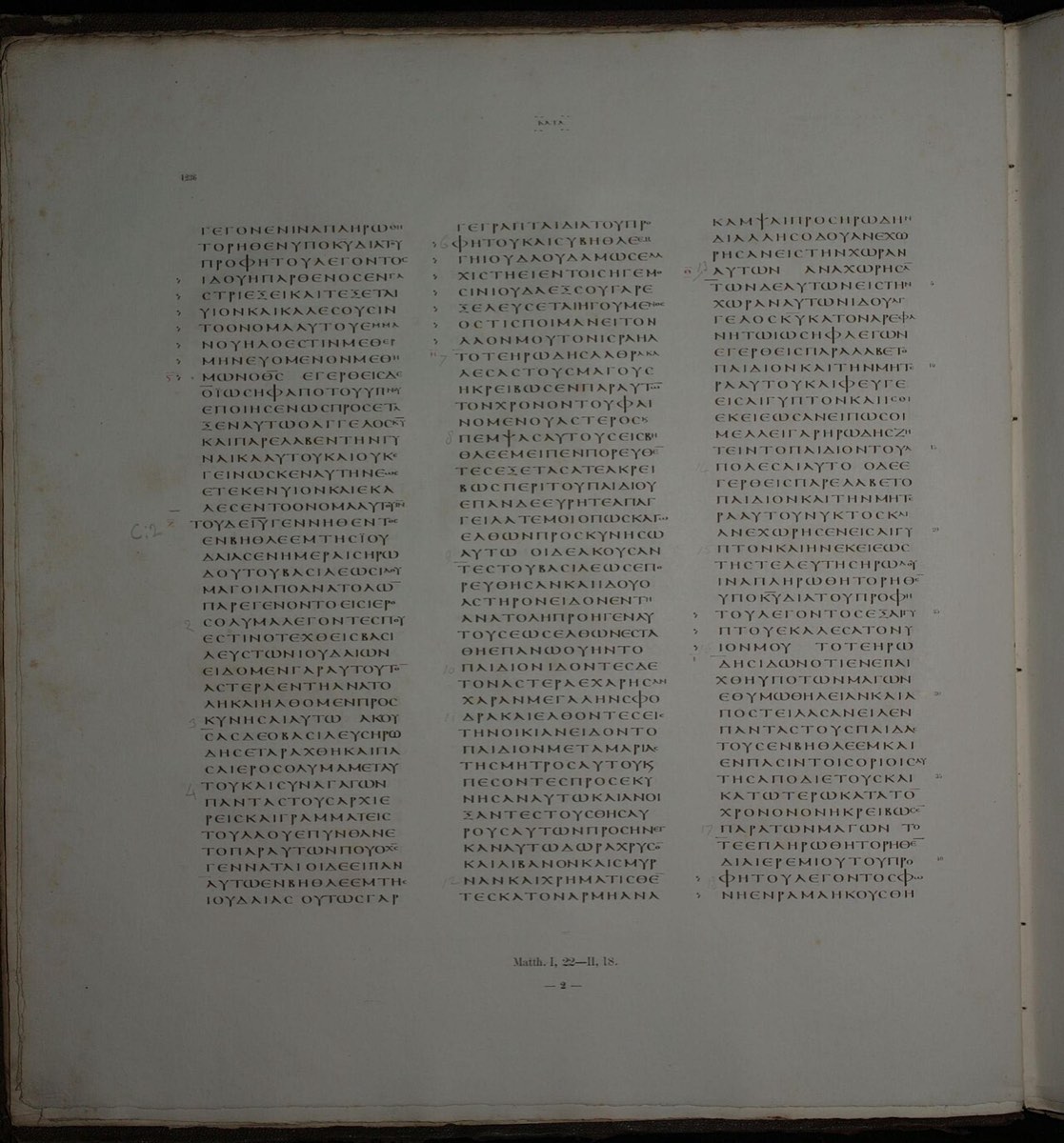
For the New Testament, the number is large: about 5,700 Greek manuscripts, plus thousands more in Latin and other languages. The oldest fragment, the P52 papyrus, carries verses from John and is dated between A.D. 117 and 160. The Codex Sinaiticus and Codex Vaticanus, from the 4th century, preserve almost the entire text. Compared with classical works, known from only a handful of late copies, the biblical record is abundant.
Textual criticism weighs these witnesses by age, quality, geographic spread and textual family, and examines each variant using principles such as the idea that the more difficult or shorter reading tends to be the original. The result appears in critical editions, such as the Nestle-Aland, which list the variants in plain view of any reader. Estimates put the number of New Testament variants in the hundreds of thousands, but most are spelling differences or otherwise trivial. Few affect meaning.
Three famous cases
A few passages show the method at work. The explicit Trinitarian formula of 1 John 5:7-8, the Comma Johanneum, does not appear in early Greek manuscripts and surfaces in late Latin copies instead. Erasmus left it out of his edition of the Greek New Testament and eventually gave in to pressure to include it. Today most critics consider it a Latin addition.
Verses 9 through 20 of Mark 16 are missing from the Codex Sinaiticus and Codex Vaticanus, use vocabulary distinct from the rest of the gospel, and begin abruptly after verse 8. One plausible explanation is that the ending at 16:8, with the frightened women, struck early Christians as unsatisfying. The story of the woman caught in adultery, in John 7:53 to 8:11, is likewise missing from the oldest Greek manuscripts and appears in different places in others. Many modern translations keep both passages, with a footnote noting the doubt.
In these cases, what is visible is growth of the text over time, not concealment. The proof that there is no secret is that scholars themselves discovered it and published it.
The canon and the "hidden" texts
The canon, the list of books accepted as Scripture, also took shape gradually. On the Jewish side, the Torah was recognized first, then the Prophets, and finally the Writings. The idea of a "council" at Jamnia that supposedly closed the list around A.D. 90 is now disputed by specialists. Catholics and Orthodox Christians include the deuterocanonical books, present in the Septuagint, while Protestants call them apocryphal.
In the New Testament, Paul's letters circulated early, and Irenaeus defended the four gospels around A.D. 180. Athanasius's Easter letter, in 367, is the first list with exactly the 27 books used today, later confirmed by regional synods in North Africa. Among the criteria that mattered were a connection to an apostle, consistency with the prevailing faith, use in churches and antiquity.
The texts left out are not locked away. The apocrypha and pseudepigrapha, such as the Book of Enoch, and the Gnostic writings from Nag Hammadi, discovered in 1945, among them the Gospel of Thomas, are published and studied. They generally date from the 2nd to the 4th centuries, advocate theologies quite different from those of the canonical gospels, and had no clear apostolic connection. What they reveal, above all, is the plurality of early Christianity.
Translating is already interpreting
That leaves translation. Every translation makes choices about rare words, metaphors and theological terms, ranging from literal versions to sense-for-sense ones. The differences between Portuguese-language Bibles reflect these challenges, not a plan of adulteration.
The question of what was hidden, then, has an answer that is less seductive and more honest: little was hidden, and much was changed visibly, documented and discussed in public. Anyone who wants to read the Bible with clear eyes needs to know it has a history of transmission, and that history is available to anyone who looks.
Sources and references for this article
The historical reliability of the New Testament (Logos Bible Software blog)Rodrigo Silva, Myths about the writing and formation of the Bible (Adventist News, Brazil)New Testament (Wikipedia)Biblical manuscript (Wikipedia)List of New Testament papyri (Wikipedia)Translated from Portuguese. This article was rewritten from a post on the original blog, in Portuguese. Read the original
Get the best articles of the week
One email a week, no spam. Unsubscribe anytime.
Read next
 Western esotericism · VideoThe Gospel of Mary: the ancient text in which Magdalene teaches and Peter doubts her
 Western esotericism · VideoGnosticism: the movement that contested the meaning of Jesus with the early Church
 Science and consciousnessVedānta and quantum physics: what the observer has to do with reality
 The East · VideoŚūnyatā: what Nagarjuna meant by emptiness, and what it is not
 Western esotericism · VideoThe Reality of the Rulers: the Nag Hammadi text that reinterprets Genesis