God and Mammon: what Kardec says about wealth, attachment, and money
For Kardec, wealth is a trial and a responsibility: what condemns it is attachment, not possession itself, and the owner is only a custodian.
· 3 min read · Sources

In 1 minute
- Kardec comments on Jesus's saying about serving God or Mammon, the name the Gospel gives to material wealth.
- For him, fortune is not an evil in itself, but a difficult trial that stirs up pride and selfishness, and it should serve the common good.
- By Spiritist doctrine, man is merely a custodian of goods and takes only the soul's riches with him; wealth and poverty alternate across lifetimes.
Full article
"Ye cannot serve God and mammon." In the Sermon on the Mount, according to the Gospel of Matthew, Jesus sets two masters face to face, and mammon is the name the saying gives to material wealth. The sentence has traveled down the centuries as a warning, and the question it leaves is a practical one: what to do with money without being ruled by it?
Chapter 16 of Allan Kardec's The Gospel According to Spiritism, published in 1864, answers with the blend that characterizes the book: the author's commentary and messages attributed to spirits. The idea of multiple lifetimes, and the explanation of inequality through them, are Spiritist doctrine, not demonstrated facts. As a philosophy of how to use wealth, however, the argument can be weighed by any reader.
Two masters
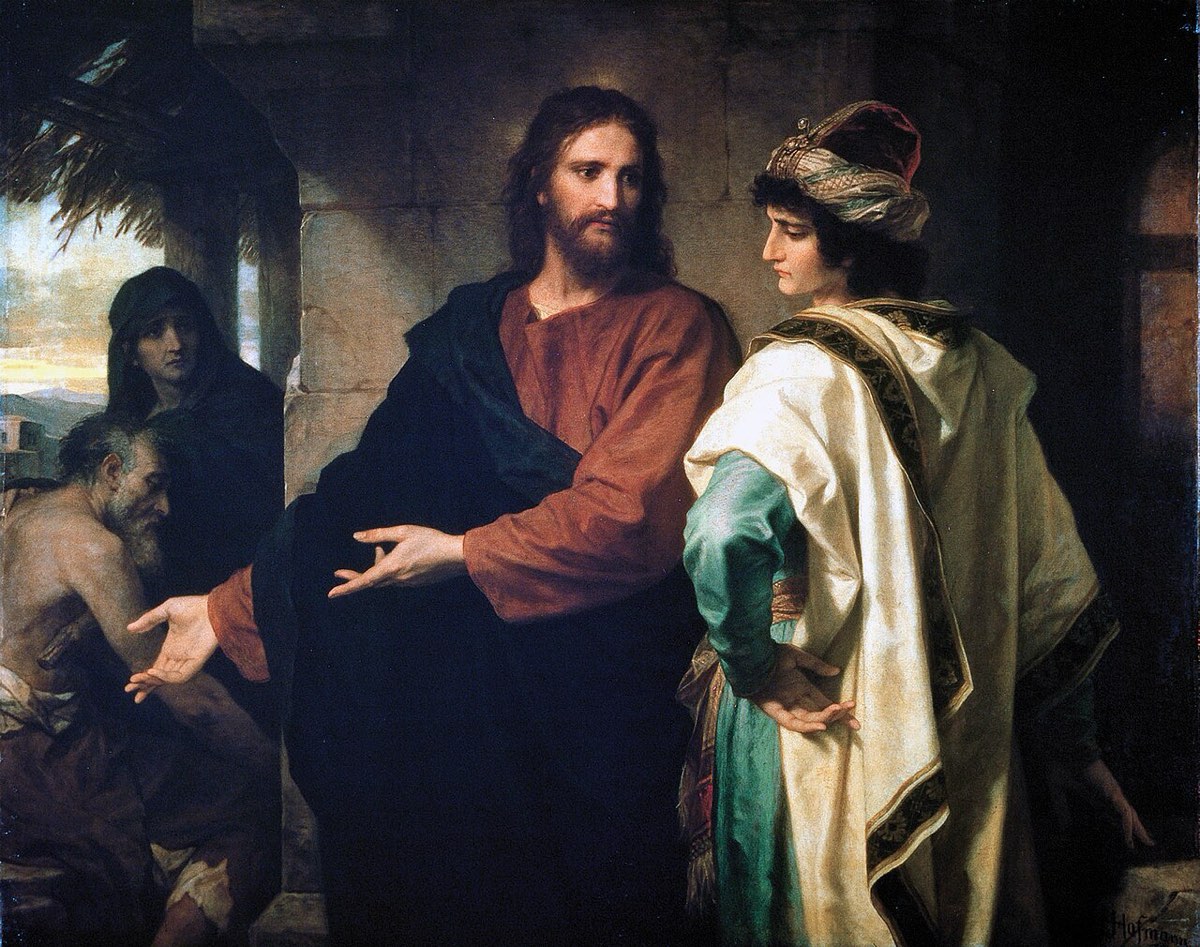
In the text, mammon symbolizes the promise of security, power, and pleasure that money makes. Attachment to earthly goods would lead the spirit astray, and greed, pride, and sensuality are bonds that enslave. The best-known warning — the one about a camel passing through the eye of a needle before a rich man enters the kingdom of heaven — appears in Matthew, in the episode of the rich young man.
Kardec adds an important caveat: wealth is not an evil in itself. It is a difficult trial, because it stirs up pride and selfishness, dazzles the senses, clouds judgment, and turns the heart away from charity. The rich man's virtue, he says, does not lie in being poor, but in knowing how to put wealth to good use.
Two parables
In the parable of the rich young man, Jesus invites a man who keeps the law to sell his possessions and follow him, and the man refuses, bound to his belongings. Kardec concludes that obeying the commandments is not enough: one must go further, into renunciation, and the test exposes a lack of full charity.
In the parable of Lazarus, told in Luke, a rich man lives in luxury while a beggar suffers at his gate. After death, Lazarus is received into Abraham's bosom, and the rich man suffers. The chapter draws from this that the good that is not shared turns against whoever kept it.
What one takes along
In a message attributed to the spirit Pascal, man truly owns only what he can carry into the spirit world: intelligence, virtues, knowledge, charity. Material goods are said to be temporary loans. What matters, in this reading, is arriving in the next world richer than one arrived in this one.
A role in society
Kardec acknowledges a use for fortune: it finances public works, drives labor and science, and, well used, aids charity. As for inequality, he explains it through individual trials. It would not be an injustice, since everyone would alternate between wealth and poverty across several lifetimes, and the difference would allow for the exercise of resignation, generosity, and detachment.
The spirits cited distinguish the useful rich man from the selfish one. In a message attributed to Fénelon, the true rich man distributes, aids, supports, and instructs; the miser is the servant who buried his talent, and the ostentatious man spends on himself what was entrusted to him for others. The synthesis comes as a maxim: "Everything belongs to God. Man is merely a custodian."
Other messages go in the same direction. A guardian spirit laments those who live only to accumulate, for whom fortune becomes a tyrant. Saint Louis says that giving to the poor is paying a debt to God, and that wealth should be passed on as a legacy of responsibility, not as absolute possession.
The balance proposed
The chapter does not call for renouncing fortune. It calls for inner detachment, use for the common good, accepting loss with faith, and refusing to trade lasting values for passing interests. The rich man is said to be a steward, and wealth, in the chapter's closing image, can be either a step toward a fall or a bridge to heaven. The choice belongs to each person, and the reckoning, the text says, will come with precision.
Sources and references for this article
_O Evangelho segundo o Espiritismo_ (The Gospel According to Spiritism), Allan Kardec, chapter 16
The Gospel According to Spiritism, Wikipedia (1864 publication and overview)Allan Kardec, WikipediaMatthew, chapter 6 ("ye cannot serve God and mammon"), Almeida Corrigida Fiel BibleMatthew, chapter 19 (the rich young man and the camel), Almeida Corrigida Fiel BibleLuke, chapter 16 (the rich man and Lazarus), Almeida Corrigida Fiel BibleTranslated from Portuguese. This article was rewritten from a post on the original blog, in Portuguese. Read the original
Get the best articles of the week
One email a week, no spam. Unsubscribe anytime.
Read next
 Death and beyond · VideoAllan Kardec's “testament”: what is known and what is narrative
 Death and beyondHow Allan Kardec tested spirit messages and assembled the Spiritist codification
 Vedanta and YogaGita, lesson 5: a blind king's question and the field of dharma
 Vedanta and Yoga · VideoThe inner war: what the Bhagavad Gītā says to those caught between duty and fear
 Death and beyond · VideoThe rock that asks about love: Peter's near-death experience, in 1974