The inner war: what the Bhagavad Gītā says to those caught between duty and fear
On the battlefield, Arjuna freezes, and Kṛṣṇa answers with the immortal soul, duty, desire as the enemy, and action without attachment to its fruits.
· 3 min read · Sources

In 1 minute
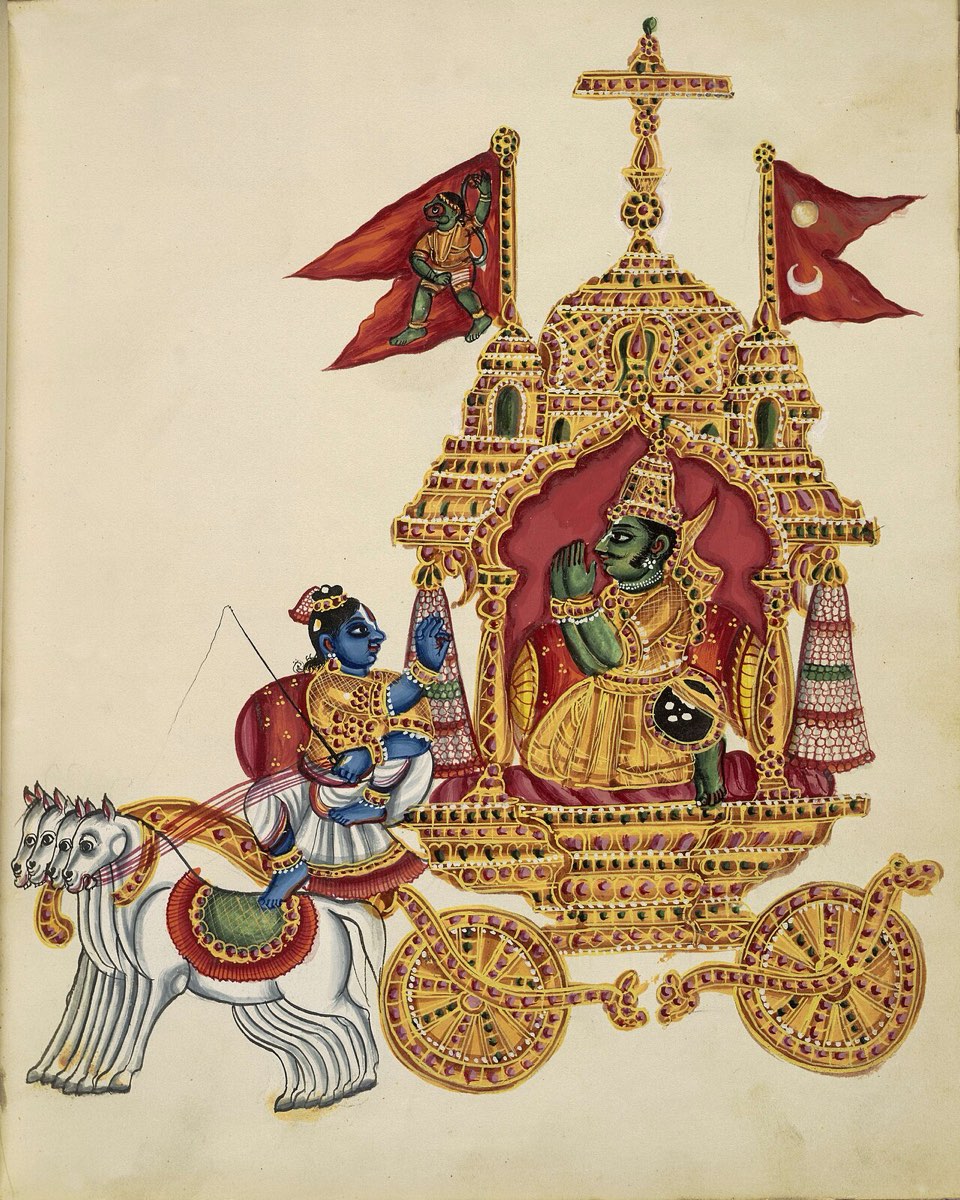
- In the Bhagavad Gītā, the warrior Arjuna freezes at Kurukṣetra facing relatives and friends on the other side, and the god Kṛṣṇa responds to his crisis.
- The central teachings are that the soul does not die, that each person must fulfill their own duty (dharma), that desire is the inner enemy, and that one must act without clinging to the results.
- A reading widespread in videos treats the poem as a metaphor for each person's inner battle, not as a manual of war.
Full article
On the field of Kurukṣetra, about to begin a war, the warrior Arjuna drops his bow. Before him, among the enemy ranks, stand relatives, teachers, and friends. He has no doubt about tactics. He has a crisis of conscience. It is from this scene that the Bhagavad Gītā, the “Divine Song,” begins — one of India's most-read texts and, for many readers today, a map of the battle each person wages within.
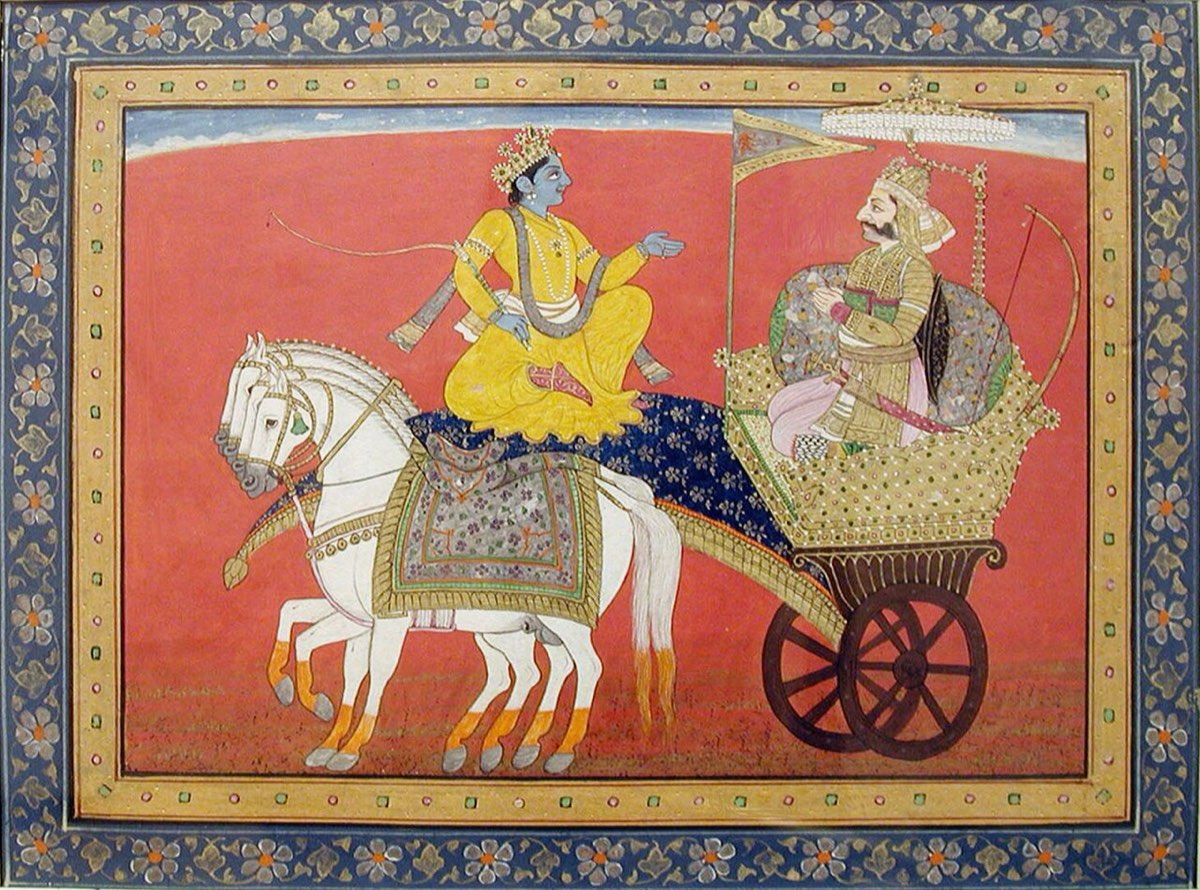
The Gītā is a dialogue more than two thousand years old, part of the epic Mahābhārata, between Arjuna and Kṛṣṇa, who in the tradition is the god manifested in human form and drives the prince's chariot. For the tradition, Arjuna represents a soul confused about its duty, and Kṛṣṇa the voice that clarifies it. The reading that follows, presented in a devotional and interpretive video, is not the only one possible: the text has also been read as a treatise on ethics, politics, and action.
Arjuna's question
The prince's hesitation is that of anyone torn between what they feel and what they must do. Why fight for a throne he does not even want, against people he loves? The question, in this reading, is less about the war outside than the one within.
The soul does not die
Kṛṣṇa's first answer dissolves the fear of death. The soul, the ātman, is neither born nor dies. It merely changes bodies, the way one changes clothes. Understanding this would relieve Arjuna of the dread of the consequences of killing.
Duty and desire
The second answer concerns dharma, each person's own duty. Arjuna is a kṣatriya, a warrior, and his duty is to fight for justice. Fleeing it would mean denying his own essence, and the same would hold for anyone who ignores their inner calling, however hard it may be to follow. The Gītā states that even imperfectly fulfilling one's own duty is worth more than fulfilling someone else's well.
The third concerns desire, presented as the true enemy, located within rather than on the other side of the field. Attachment, ambition, vanity, and the need for approval would form a quiet prison. What looks like freedom — doing what one wants — would be servitude to desire.
Acting without expecting the fruits
For this reading, the heart of the teaching is niṣkāma karma, action without expectation of outcome. Everyone has a right to act, never to the fruits of action. One does what must be done and releases what will come. The value lies in the integrity of the act, not in success.
The vision of the universe
The most mystical passage comes when Arjuna asks to see Kṛṣṇa in his divine form. Mouths that devour everything appear, arms that encircle the world, gods, monsters, time, and death, all contained within him. Kṛṣṇa presents himself as time, destroyer of worlds. Arjuna understands that the war is already decided and that he is merely an instrument, and his doubt dissolves.
The poem culminates in devotion, bhakti. Described as surrender without ego, it is not about asking for favors but about acting with the heart given over to service. Kṛṣṇa wants a conscious warrior, not a worshiper on his knees.
The three gunas
Kṛṣṇa also explains that existence is shaped by three guṇas, or qualities: sattva, purity and wisdom; rajas, passion and desire; tamas, ignorance and inertia. Peace would come from recognizing these forces and moving beyond the oscillation of mind they cause.
A war with no army
The Gītā is not, in this key of reading, a battle manual, but a map of the soul in conflict. Every time someone hesitates between speaking and staying silent, or questions their own purpose, they would be at Kurukṣetra. The path Kṛṣṇa points to is short to state and hard to follow: do your duty, release the outcome, and remember what is eternal.
Sources and references for this article
Video about the Bhagavad Gītā (channel unidentified)
Bhagavad Gītā
Bhagavad Gita, Portuguese WikipediaTranslated from Portuguese. This article was rewritten from a post on the original blog, in Portuguese. Read the original
Get the best articles of the week
One email a week, no spam. Unsubscribe anytime.
Read next
 Vedanta and Yoga · VideoKarma Yoga: acting without attachment to the fruits, the yoga of action
 Vedanta and YogaThe value of values: why Vedānta begins by preparing the mind
 Accounts and channelings · VideoMay 24 and the “Children of the Sun”: a belief in a collective awakening, and why it draws people in
 Western esotericism · VideoThe “1775 Bible” and the passages the Church allegedly suppressed: what is claimed
 Vedanta and Yoga · VideoWhat Dies When Someone Dies? The Answer from Ramana Maharshi and Advaita Vedanta