Gita, lesson 3: the Mahābhārata as the setting for the teaching
The third lesson places the Gita within the Mahābhārata and distinguishes poetic text, which moves, from revealed text, which teaches.
· 2 min read · Sources

In 1 minute
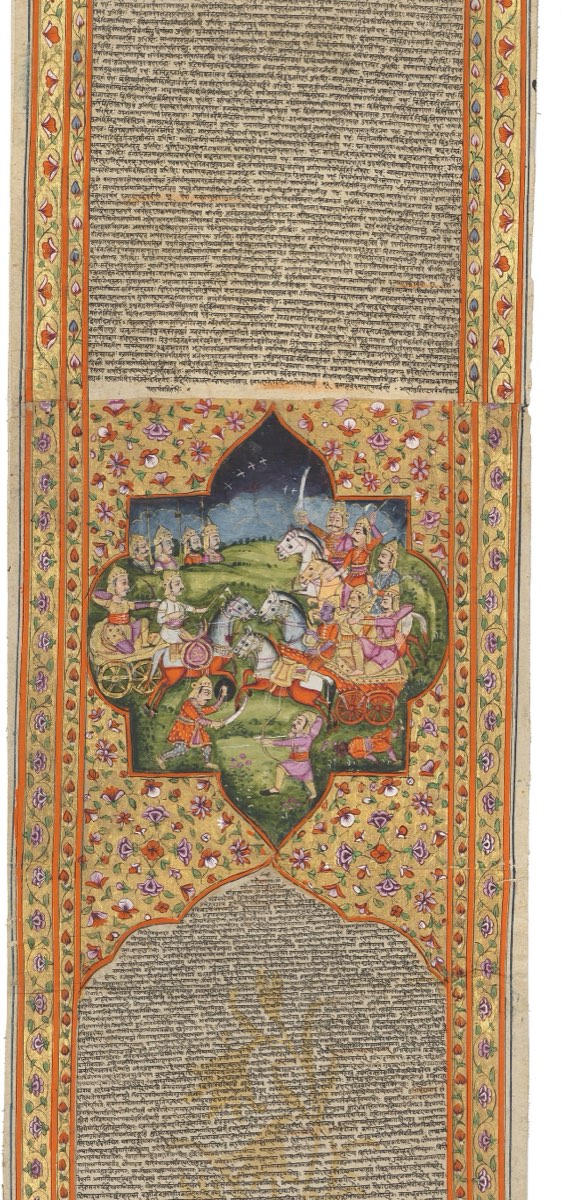
- The Gita is part of the Mahābhārata, an epic Swami Dayananda reads as a portrait of the human condition.
- Krishna is presented as an avatāra, a form Īśvara takes on in order to teach, not as an object of blind worship.
- The Gita acts as śāstra, a text of knowledge, even while embedded within a work of poetry.
Full article
To understand the Bhagavad Gītā, one needs to know where it sits. The setting is the Mahābhārata, the vast Indian epic in which the dialogue between Krishna and Arjuna is embedded, the subject of the third lesson in Swami Dayananda Saraswati's series.
An epic that mirrors life
The Mahābhārata is read as a portrait of the human condition. It holds heroism, compassion, anger, humor, and tragedy — what the tradition calls rasas, the "flavors" of emotion. The text thus functions as a psychological and cultural mirror: readers recognize their own dramas in its characters. The maxim that what is not in the Mahābhārata does not exist holds here, taken as an indication of scope, not as dogma.
Krishna as avatāra
On this stage appears Krishna, whom the tradition recognizes as an avatāra, a form that Īśvara, the Lord, takes on. In the lesson's reading, Īśvara is everything that exists, and the avatāra is an accessible form of that whole, which helps a human being grasp what has no form. Krishna serves the teaching and dharma, the just order of things. He is not an idol to be worshipped without understanding.
Poetry and revelation
The lesson also separates two types of text. Kāvya is poetic and dramatic work, which teaches through emotion and art, with symbolic images that do not call for a literal reading. Śāstra is a text of knowledge, grounded in revelation, like the Vedas. The Gītā sits within a kāvya, but functions as śāstra: its role is to reveal something about the reader, not merely to inspire.
Knowledge without borders
Finally, there is a critique of traditions that dismiss all knowledge outside their own texts. According to Dayananda, Vedānta imposes no such limit, and the Gītā is an instrument of liberation, not of exclusion.
The bridge to the next lesson is clear: before listening to Krishna, it helps to know the stage of errors, conflicts, and choices on which he appears.
The complete study is in the book A Essência do Bhagavad Gītā (The Essence of the Bhagavad Gita), by Swami Dayananda Saraswati.
Sources and references for this article
A Essência do Bhagavad Gītā (The Essence of the Bhagavad Gita), Swami Dayananda Saraswati (book)
Translated from Portuguese. This article was rewritten from a post on the original blog, in Portuguese. Read the original
Get the best articles of the week
One email a week, no spam. Unsubscribe anytime.
Read next
 Vedanta and YogaListening to see: what Vedānta asks of those who want to know themselves
 Vedanta and YogaConsciousness with a body: what Vedānta says the “self” is
 Science and consciousnessVedānta and quantum physics: what the observer has to do with reality
 Western esotericism · VideoThe Kybalion, chapter 1: a tradition from teacher to student, and what history says
 Vedanta and Yoga · VideoThe straw of Agni: what the Kenopanishad teaches about the pride of the gods