Gita, lesson 1: the text that wants to clarify, not just inform
First chapter in the series: the Gita as a means of knowledge within Vedānta, and suffering as a problem of self-image.
· 2 min read · Sources

In 1 minute
- The Gita is one of the three foundational texts of Vedānta, alongside the Upaniṣads and the Brahma Sūtras.
- In Swami Dayananda's reading, suffering arises from a mistaken image of oneself, not from sin or circumstance.
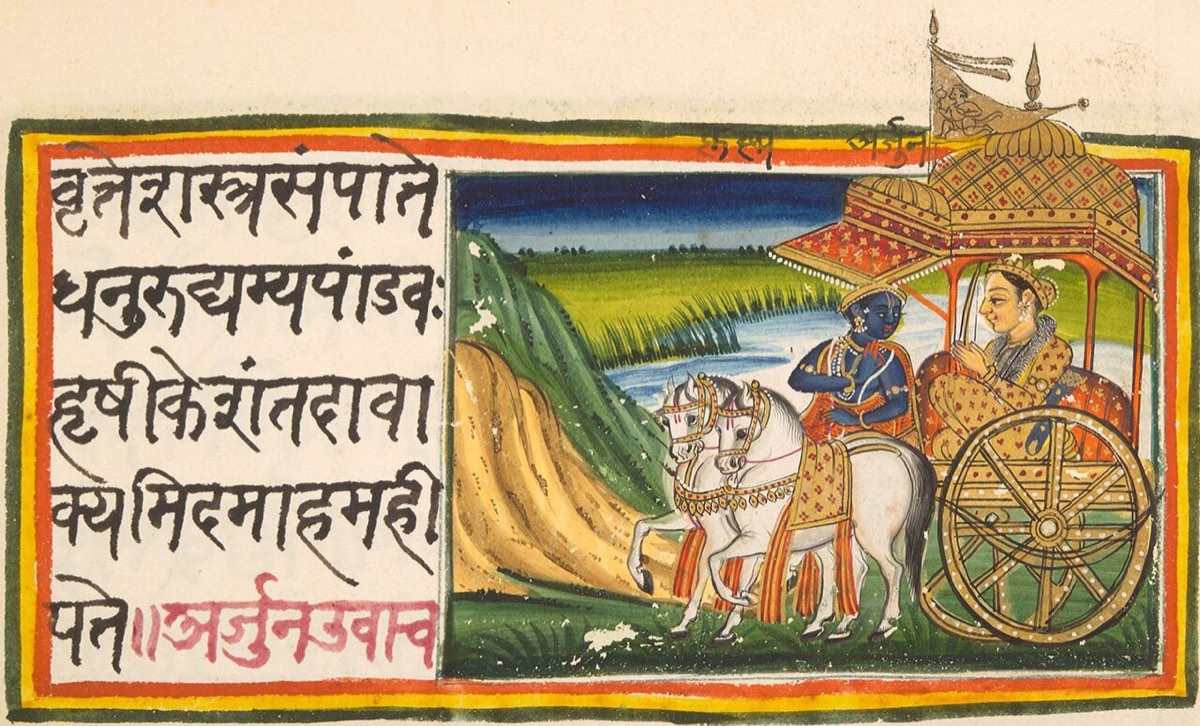
- The book presents itself as a dialogue between teacher and student, one that makes room for doubts and confusion.
Full article
What is the role of a sacred text: to console, to order conduct, or to clarify something about the reader? The first chapter of Swami Dayananda Saraswati's series on the Bhagavad Gita answers with the third option. The Gita, it holds, is a pramāṇa, the Sanskrit term for a valid means of knowledge, one that reveals something the reader does not yet see.
One of Vedānta's three pillars
Vedānta, the Indian school of reflection on the Self, rests on three texts grouped under the name prasthāna traya: the Upaniṣads, the Brahma Sūtras, and the Gita. The Upaniṣads carry the original teaching, the Brahma Sūtras organize it logically, and the Gita presents it as conversation. Dayananda argues that the Gita's eighteen chapters carry the same weight as the Upaniṣads, because they convey the same vision.
The problem lies in self-image
The chapter's central idea is that human suffering does not come from a sin to be forgiven, nor from the outside world, but from a mistaken image each person builds of themselves. Those who judge themselves incomplete start chasing money, status, or paradise as a remedy, and remain forever dependent on whatever they pursue.
In this reading, the word “spirituality” only makes sense once it begins by taking responsibility: if the problem lies in how one sees oneself, the solution lies there too, and the path is knowledge. Freedom, then, would not be a reward reserved for after death. It would be the Self's own nature, needing only clarity to be recognized.
A teaching in the form of dialogue
The chapter also comments on the text's form. The Gita is a conversation between a teacher and a student, and that structure allows doubts, fears, and resistance to surface and be addressed. For that reason, according to Dayananda, this is not the start of a journey of blind devotion, but a study in which understanding comes before faith.
The full study appears in the book The Essence of the Bhagavad Gita, by Swami Dayananda Saraswati.
Sources and references for this article
The Essence of the Bhagavad Gita, Swami Dayananda Saraswati (book)
Translated from Portuguese. This article was rewritten from a post on the original blog, in Portuguese. Read the original
Get the best articles of the week
One email a week, no spam. Unsubscribe anytime.
Read next
 Vedanta and YogaListening to see: what Vedānta asks of those who want to know themselves
 Vedanta and Yoga · VideoDissolving the mind: what Vedānta means by freeing oneself from thought
 Science and consciousnessVedānta and quantum physics: what the observer has to do with reality
 Science and consciousnessQuantum physics and Vedanta: where the analogies help and where they mislead
 Vedanta and Yoga · VideoThe straw of Agni: what the Kenopanishad teaches about the pride of the gods